
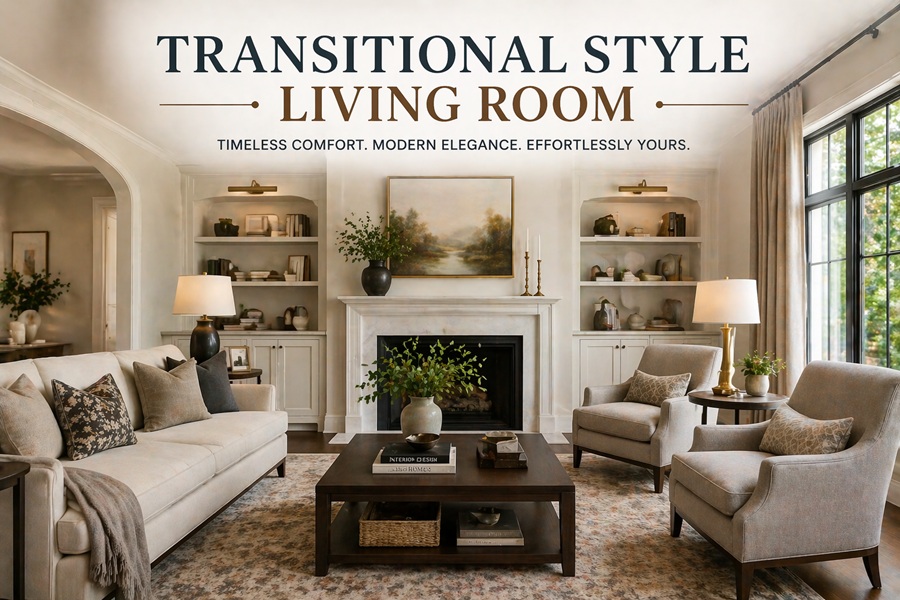
There’s a specific kind of living room that people can’t stop photographing for their mood boards, but struggle to describe. It has the clean lines of a modern space but the comfort of a classic one. Traditional bones, but nothing fussy. A velvet sofa that looks old-money next to a sculptural floor lamp that looks brand-new. The room feels finished without feeling decorated. That’s transitional style doing its quiet work.
A transitional style living room is the hardest aesthetic to pull off from a mood board alone, because it isn’t a look — it’s a balance. Too much traditional and you land in your grandmother’s sitting room. Too much modern and the warmth evaporates. The magic is in the tension between the two, and once you understand how professional designers actually hold that tension, you can build it in any space, on any budget.
Here’s the working formula, the trend shifts that matter in 2026, and the mistakes that quietly ruin otherwise beautiful rooms.
What Transitional Style Actually Is (and Isn’t)
Transitional design is the deliberate blending of traditional and contemporary elements in roughly equal measure. That’s the textbook definition, and it’s almost useless in practice. The real definition: a transitional room takes the silhouettes of traditional furniture — curved arms, turned legs, rolled backs — and strips them of ornament, fussiness, and dated pattern. Then it takes the materials and palette of contemporary design — neutral tones, clean textures, modern lighting — and softens them with warmth, layering, and a few antique or heirloom touches.
The easiest way to spot a true transitional space: cover the furniture with your hand and look at the walls, windows, and floors. Pure contemporary. Cover the walls and look at just the furniture. Leans classic. That push-pull is the whole thing.
Transitional vs. contemporary vs. modern farmhouse
These three get confused constantly. Here’s the shortcut:
- Contemporary: Whatever’s current — leans newer, cleaner, more architectural. No traditional references.
- Modern farmhouse: Country-leaning, lots of shiplap, mason jars, and distressed wood. Traditional elements are rustic, not refined.
- Transitional: Refined traditional forms (Chesterfield sofas, wingback chairs, turned lamps) meeting clean contemporary backgrounds. No rustic elements, no heavy patterns, no fuss.
The Working Formula
Designers who build transitional living rooms for a living follow a loose 50/50 principle, but within that, they layer in a specific ratio.
The 50/50 of silhouettes
Half your major furniture pieces should read traditional in shape — a tufted or roll-arm sofa, a wingback chair, a turned-leg coffee table. The other half should read modern — a sleek metal floor lamp, a sculptural accent chair, an abstract piece of art. If all your pieces lean one direction, the room tips out of balance.
The 70/30 of palette
Seventy percent of the room lives in one continuous neutral family — creams, oats, mushroom, warm greys, soft taupes. Thirty percent introduces depth through deeper tones: espresso, navy, forest green, cognac leather, aged brass. Transitional rooms almost never use more than three colors total, and they rarely include any true primary shades.
The 80/20 of materials
Eighty percent of surfaces and textiles should feel soft, tactile, and classic — linen, velvet, wool, brushed cotton, natural wood. Twenty percent brings in harder, more contemporary materials: metal, stone, glass, lacquer. A linen sofa with a polished stone coffee table. A velvet armchair under a sculptural brass arc lamp. The textural contrast is what keeps the room from feeling too sweet or too cold.
Building the Room Piece by Piece
The sofa: your biggest commitment
A true transitional sofa has traditional bones and contemporary restraint. Rolled arms, tight back cushions (not overstuffed), clean tailoring, and no skirt. Tuxedo sofas, English roll-arm sofas, and modern Chesterfields all work. Avoid anything with exposed wood trim, tassels, or decorative fringing.
Budget-friendly: Article’s Sven or Ceni in a neutral linen-blend, Crate & Barrel’s Lounge II in performance fabric, or an IKEA Stocksund (often mistaken for a designer piece).
Premium: A Verellen custom sofa, a RH Cloud in performance linen, or a George Smith roll-arm for the deepest pockets in the room.
The accent chair: where you introduce modern
One accent chair should lean noticeably more modern than the sofa. A curved swivel chair in bouclé. A cane-back lounge chair. A low-profile sculptural piece. This is where transitional rooms earn their “current” read — without a modern accent, the room drifts into pure traditional territory.
Coffee table: the anchor of balance
The coffee table is where most people go wrong. Too ornate and the room reads old. Too industrial and it breaks the warmth. The sweet spot: a simple silhouette in a beautiful material — a round travertine table, a rectangular oak plank, a stone-topped iron base. One anchor material, no decorative hardware, no glass-and-chrome combos.
Lighting: the single biggest lever
If your transitional living room isn’t working, lighting is almost always the problem. Overhead light alone flattens everything. You want:
- One sculptural floor lamp (modern silhouette) near the sofa
- Two matching table lamps (traditional silhouette) on console or side tables
- One statement overhead fixture — a modern chandelier or pendant that contrasts the traditional bones below
All bulbs warm (2700K or lower), all on dimmers, all turned on at the same time in the evening. This is how expensive rooms look expensive.
Window treatments
Transitional windows want floor-puddling linen drapery mounted close to the ceiling, not at the window frame. Hung high and wide, they make rooms feel taller and more considered. Skip valances, swags, and anything with tasseled tiebacks — those tip the room into dated traditional territory immediately.
Modern Style Crossovers Worth Knowing
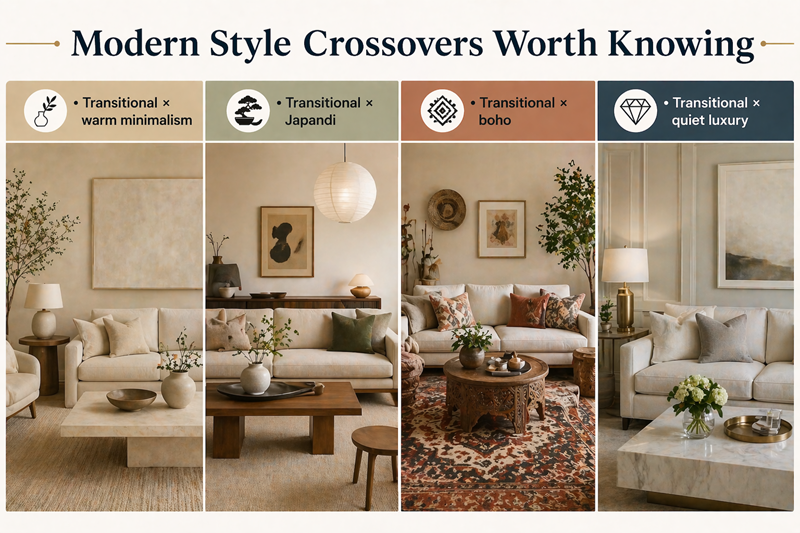
Transitional style absorbs adjacent aesthetics beautifully. A few crossovers that are especially strong in 2026:
- Transitional × warm minimalism: Keep transitional silhouettes but push the palette even softer — plaster walls, oat linens, chalky ceramics. This is the direction quiet luxury has gone.
- Transitional × Japandi: Pair classic roll-arm sofas with low-profile Japanese-inspired side tables and handmade ceramics. Works especially well in smaller rooms.
- Transitional × boho: Add collected global pieces — a vintage Moroccan rug, a carved wooden stool, a handwoven throw — to warm up the cleaner backbone. Never let boho overtake; one or two global pieces maximum.
- Transitional × quiet luxury: Upgrade the materials without changing the silhouettes. Belgian linen sofa, honed marble coffee table, unlacquered brass lamps, handmade cashmere throw. Same formula, better bones.
Pick one direction to lean into. Trying to blend three usually produces a room that reads confused rather than curated.
The Design Psychology (Why This Works)
Transitional design is the most universally liked interior style in surveys for a specific reason: it hits the sweet spot of two opposing neurological preferences.
Familiarity bias. The brain registers traditional silhouettes — roll arms, turned legs, tufting — as “home.” These shapes echo decades of living rooms we’ve subconsciously catalogued as safe and comfortable.
Novelty reward. At the same time, the brain releases a small pleasure hit when it spots something unexpected or current. Modern art, sculptural lighting, and clean architectural lines deliver that hit.
Transitional style gives you both at once. You feel at home and impressed, which is why these rooms score high with guests of wildly different aesthetic preferences. Minimalists find them calm enough. Traditionalists find them warm enough. That’s the trick.
Mistakes That Quietly Ruin Transitional Rooms
- Matching furniture sets. A traditional sofa with a matching loveseat and matching armchair instantly kills the balance. Mix silhouettes.
- Too many patterns. Transitional leans tonal, not patterned. If you use pattern, limit it to one piece — a rug or two throw pillows, never both.
- Heavy wood tones everywhere. Dark cherry furniture, dark wood floors, and dark wood trim tips the room into pure traditional. Break it up with lighter woods, painted finishes, or metal pieces.
- Generic “greige” palettes. The beige-grey catch-all of 2017 has aged badly. Warmer, more specific neutrals (plaster, mushroom, clay, warm oat) read much fresher.
- Decorative clutter. Transitional rooms tolerate less tchotchke than traditional ones. Each surface should hold two or three intentional objects, not a collection.
- Brown leather armchairs in the wrong context. A tobacco leather armchair can anchor a transitional room beautifully — or make it feel like a dentist’s office. Pair with soft textiles and warm lighting, never with other leather pieces.
- Ignoring scale. Transitional rooms depend on furniture being the right size for the space. Oversized sofas in small rooms read traditional-crowded. Tiny furniture in large rooms reads unfinished. Measure twice.
Frequently Asked Questions
What is a transitional style living room?
A transitional living room blends traditional and contemporary design in roughly equal measure. It uses classic furniture silhouettes (roll-arm sofas, wingback chairs, turned-leg tables) stripped of ornament, combined with modern materials, palettes, and lighting. The result feels both familiar and current — never fussy, never sterile.
What’s the difference between transitional and contemporary style?
Contemporary style is purely current — clean lines, architectural forms, minimal traditional references. Transitional style deliberately keeps traditional silhouettes and softens them with contemporary palettes and materials. Contemporary skews cooler and cleaner; transitional skews warmer and more layered.
What colors work best for a transitional living room in 2026?
Warm neutrals dominate: plaster, oat, mushroom, clay, soft taupe, warm grey. Accent colors lean deep and grounded — espresso, navy, forest green, cognac. Avoid cool greys, stark whites, and high-contrast schemes, all of which read distinctly 2015–2019.
How do I make my transitional living room feel more modern?
Swap one major piece for a clearly contemporary silhouette — a curved bouclé swivel chair, a sculptural floor lamp, or a large-scale abstract artwork. Switch ceiling lighting to a modern fixture. Remove any heavily patterned textiles and replace with tonal textures.
Is transitional style going out of style?
No — it’s the most enduring interior design direction of the last two decades because it deliberately avoids chasing trends. The specific palettes and pieces update every few years, but the underlying formula (traditional silhouettes + contemporary backdrop) has remained the most popular approach to residential interiors since the early 2000s.
Can I have a transitional living room on a budget?
Absolutely. Transitional style depends more on restraint and balance than on expensive materials. A neutral IKEA or Article sofa, a single vintage or secondhand accent chair, warm lamp lighting, and a few quality textiles (real linen drapery, a good wool rug) will read more transitional than a designer room styled carelessly.
The Takeaway
A transitional style living room isn’t a style you buy off a showroom floor. It’s a formula — traditional silhouettes, contemporary backgrounds, warm neutrals, one clear modern disruption, and enough restraint to let the tension breathe. Get that balance right and the room ages beautifully, welcomes every type of guest, and photographs well in any light.
Buy slower. Mix silhouettes. Keep the palette narrow. Let one modern piece do the heavy lifting. The best transitional living rooms don’t look designed — they look inhabited by someone with taste. That’s the whole goal, and it’s more reachable than most people think.
